Mechanical means of describing hyperbolas, their foci and vertices…
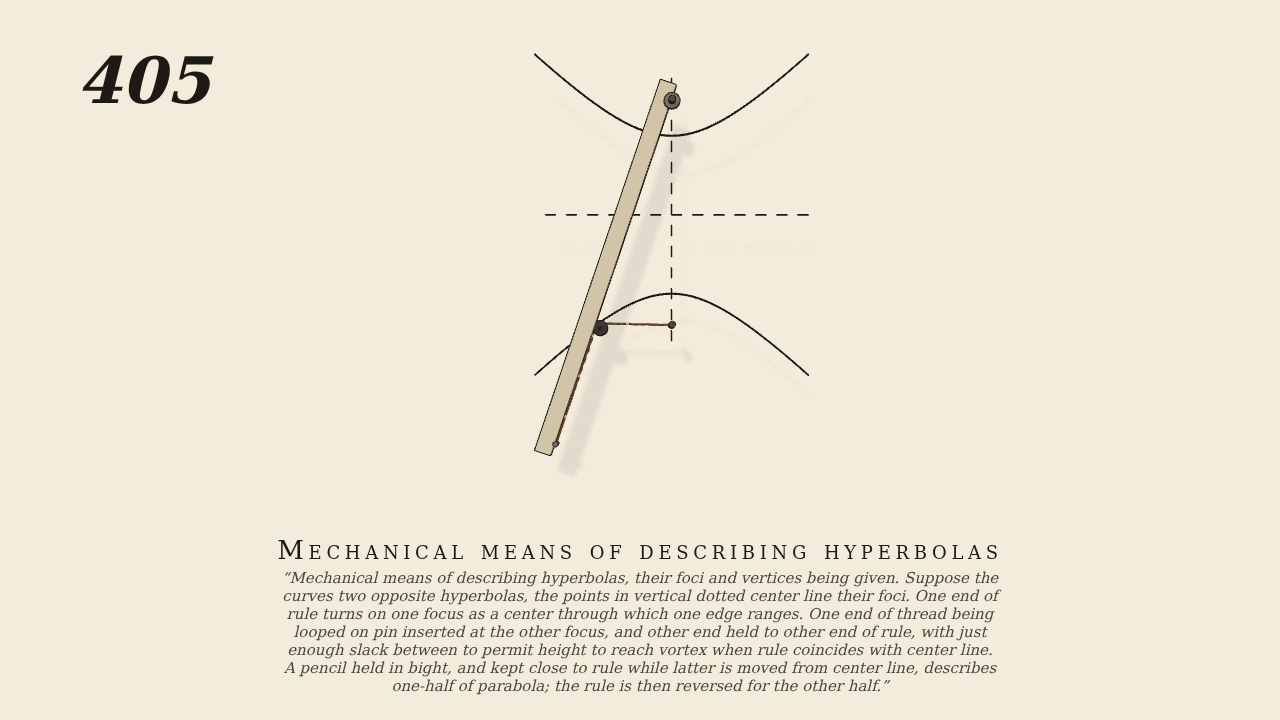
Mechanical means of describing hyperbolas, their foci and vertices being given. Suppose the curves two opposite hyperbolas, the points in vertical dotted center line their foci. One end of rule turns on one focus as a center through which one edge ranges. One end of thread being looped on pin inserted at the other focus, and other end held to other end of rule, with just enough slack between to permit height to reach vortex when rule coincides with center line. A pencil held in bight, and kept close to rule while latter is moved from center line, describes one-half of parabola; the rule is then reversed for the other half.
Only the input is driven; every other part of this model moves by physics (MuJoCo), and its ratios are measured. Run it live, change its parameters, or switch the friction off to see the output stop.
- Modelled as
- Brown's plan, the instrument lying on the drawing (no gravity): both hyperbolas drawn on the paper with the dotted axes, foci 21 cm apart, vertices 15 cm apart. The rule turns on a pin at the upper focus; the hand turning it to and fro is the one driven joint. A thread (a chain of 70 links on real contact) is tied to a pin at the lower focus and to the rule's end, 34 cm from its pin, and is taken round the pencil. The pencil rides along the rule's edge and is drawn towards the rule's pin by a light spring (the other hand), so it is held where it is by nothing but the thread. A light readout from the lower focus, pinned at the pencil, records its distance from that focus and carries nothing.
- Measured
- As the rule swings (about 7 degrees either way) the pencil's distance from the lower focus follows its distance along the rule with slope 1.088 (r² 0.9998): the difference of the focal radii stays constant, so the pencil runs along the lower hyperbola. A point pencil would give exactly 1; the thread wraps the pencil (0.45 cm to the thread's middle), and its turn round it changes over the sweep, which with a little give in the thread accounts for the 9%. Penetration stays under 0.5 mm.
- Notes
- The pencil is a 0.35 cm grooved peg so that the thread can be laid round it; the rule swings through only part of the branch to keep the simulation affordable (a fine thread is costly); Brown's text says parabola at the end where it means hyperbola, quoted as printed.
Film (MP4) · Still (PNG) · Spec (YAML) · Model (MJCF)