A parallel motion used in some of the old single-acting beam engines
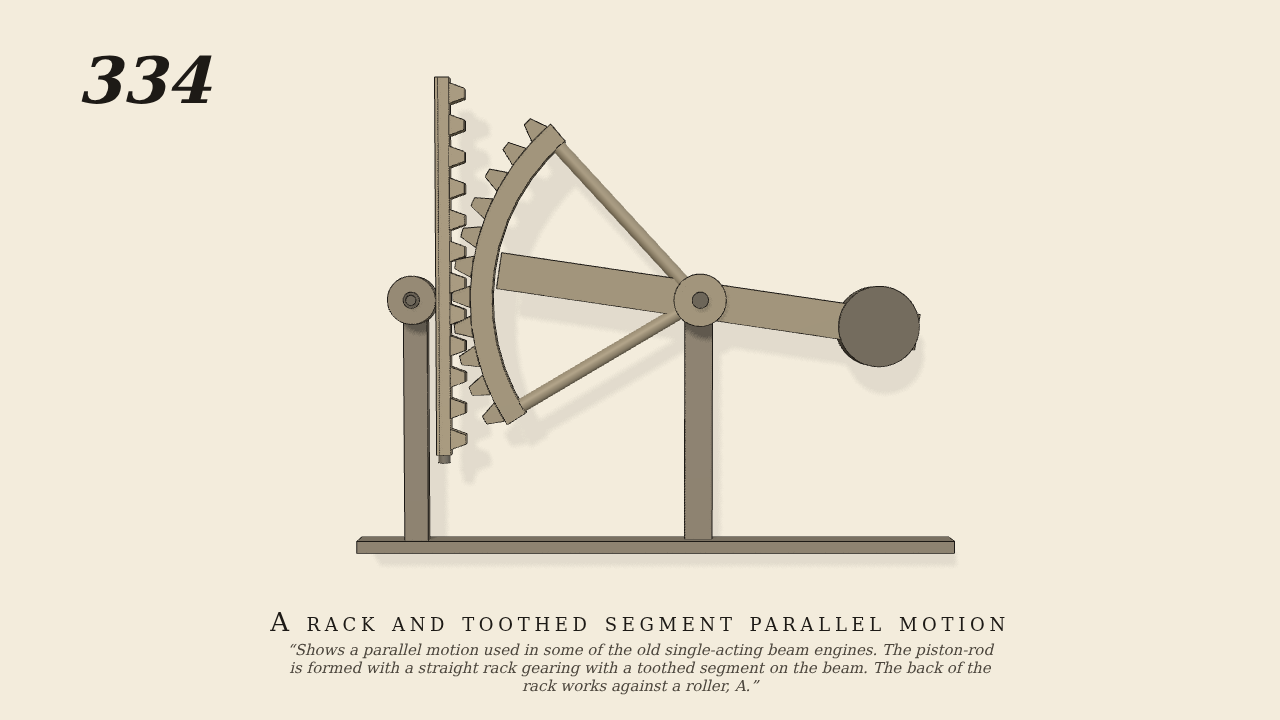
Shows a parallel motion used in some of the old single-acting beam engines. The piston-rod is formed with a straight rack gearing with a toothed segment on the beam. The back of the rack works against a roller, A.
Only the input is driven; every other part of this model moves by physics (MuJoCo), and its ratios are measured. Run it live, change its parameters, or switch the friction off to see the output stop.
- Modelled as
- The beam turns on F and is rocked through 0.2 radian each way. On its end is a toothed segment centred on F, 24 cm pitch radius, with eleven straight-flanked teeth (module 1, as No. 131). A straight rack formed on the piston-rod gears with it. The back of the rack works against roller A, 4.8 cm across, which turns freely on its stud. The piston-rod is free to move up and down and across, and only the segment's teeth and the roller place it. A weight on the beam's other end stands in for the engine's pump side. The beam is the only driven part.
- Measured
- The rack and piston-rod rise and fall 9.6 cm, 0.240 m per radian of the beam, the segment's pitch radius. Roller A rolls on the back of the rack without slipping, at 41.9 radians per metre (1/2.4 cm). The tooth load presses the rack onto the roller, which holds it in gear. It stays within 0.3 mm of its line. The deepest contact is 0.013 mm.
- Notes
- Brown gives no sizes. The segment's radius, the teeth and the roller are choices. The figure also shows an arch-head D on the beam, with a chain for the pump-rod. It is left out here. No steam is simulated. The drive is stiff enough to hold the beam's weight.
Film (MP4) · Still (PNG) · Spec (YAML) · Model (MJCF)