Duplex escapement, for watches, so called from partaking of the…
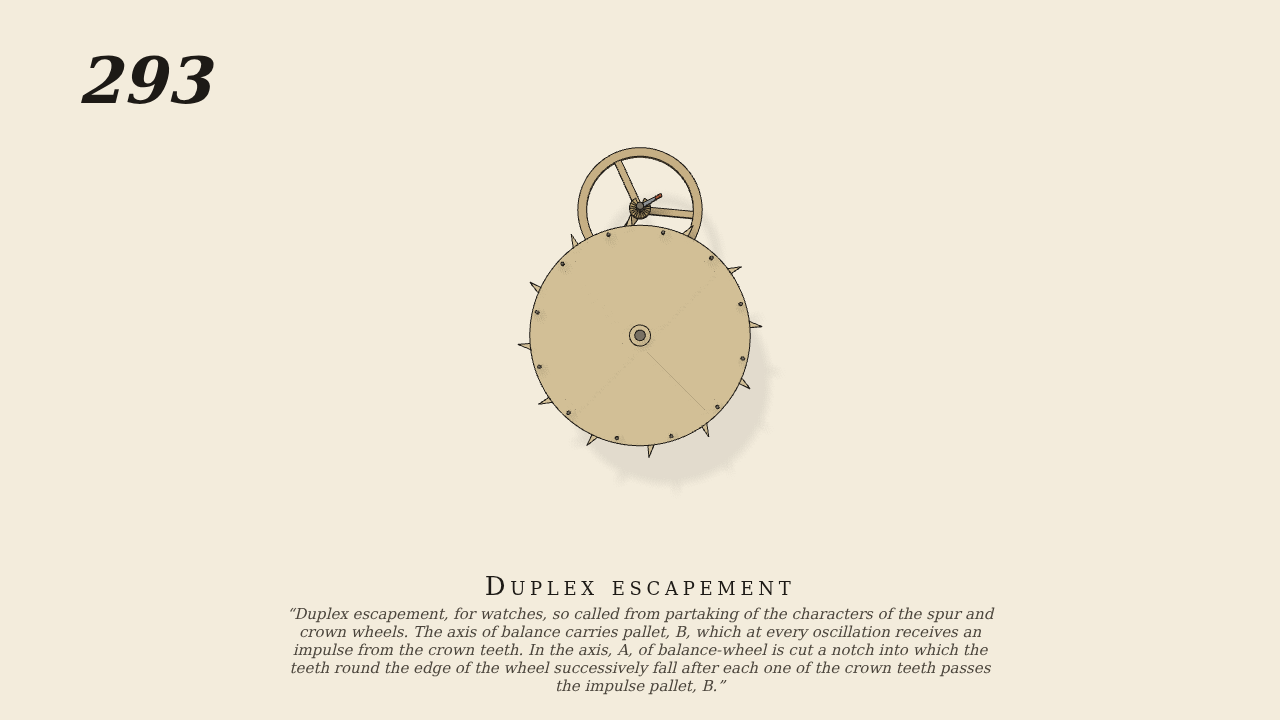
Duplex escapement, for watches, so called from partaking of the characters of the spur and crown wheels. The axis of balance carries pallet, B, which at every oscillation receives an impulse from the crown teeth. In the axis, A, of balance-wheel is cut a notch into which the teeth round the edge of the wheel successively fall after each one of the crown teeth passes the impulse pallet, B.
Only the input is driven; every other part of this model moves by physics (MuJoCo), and its ratios are measured. Run it live, change its parameters, or switch the friction off to see the output stop.
- Modelled as
- A plan of the watch (gravity off). The balance's axis A carries its spring, a small roller with a notch 50° wide, and the impulse pallet B. The escape-wheel has 12 spur teeth round its edge (tips at radius 7 cm) and 12 crown teeth, pins standing up from its face at radius 6 cm. The tips' path passes 0.3 cm below A's axis, so the tip that is waiting rests against the side of the roller (the frictional rest). When the balance swings counter-clockwise the notch comes round to the tip; the tip falls in and crosses with the notch, and the wheel is free. A crown tooth then strikes B and drives the balance on (the impulse), and the next spur tooth falls on the roller. Swinging back, the notch passes the tip again: the tip drops in and is pushed back out, and the wheel turns back a little. So the wheel goes one tooth for each to-and-fro of the balance. The only input is a constant torque on the wheel (the mainspring). The balance is set going by hand: it is let go 2.6 rad from its rest.
- Measured
- The wheel goes 0.2618 rad per beat (half a tooth a beat, one tooth a to-and-fro; 0.2618 expected) over 16 beats, and in 30 s it went exactly one tooth for each of 30 to-and-fros. The swing holds at 157°. The period is 0.986 s, 1.5% faster than the balance on its spring alone (1.001 s). When the notch passes the tip on the return swing, the wheel turns back up to 0.043 rad. The deepest contact is 0.18 mm.
- Notes
- Brown gives no sizes. The tooth counts, the notch width and the pallet's place are choices. The roller is built of ten overlapping straight-sided pieces. Their inner ends taper in, so a resting tip never catches on a join. The balance's rim is drawn plain.
Film (MP4) · Still (PNG) · Spec (YAML) · Model (MJCF)