A movement used in silk machinery for the same purpose as that…
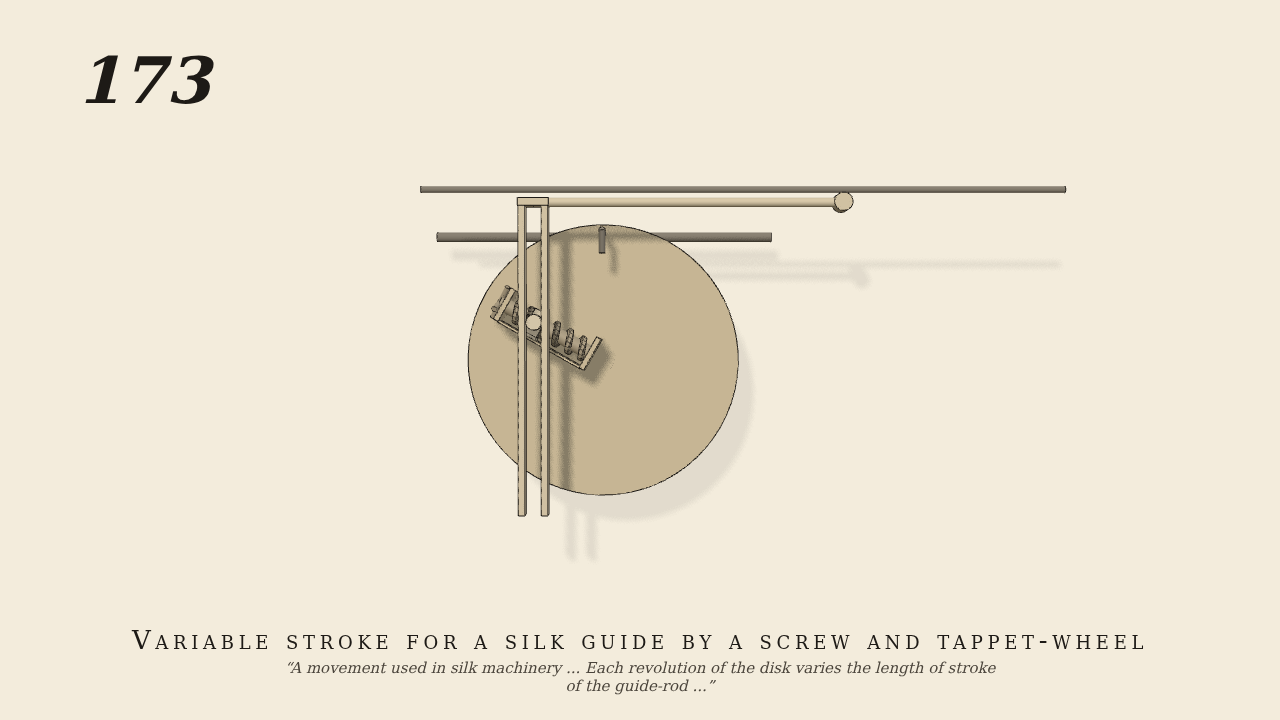
A movement used in silk machinery for the same purpose as that described in 142. On the back of a disk or bevel-gear is secured a screw with a tappet-wheel at one extremity. On each revolution of the disk the tappet-wheel comes in contact with a pin or tappet, and thus receives an intermittent rotary movement. A wrist secured to a nut on the screw enters and works in a slotted bar at the end of the rod which guides the silk on the bobbins. Each revolution of the disk varies the length of stroke of the guide-rod, as the tappet-wheel on the end of the screw turns the screw with it, and the position of the nut on the screw is therefore changed.
Only the input is driven; every other part of this model moves by physics (MuJoCo), and its ratios are measured. Run it live, change its parameters, or switch the friction off to see the output stop.
- Modelled as
- The disk (the only driven joint, 10 rpm) carries along one radius, in bearings on its face, a screw with a real thread (pitch 1.2 cm, 87 loft segments), held from turning on its own by friction in its bearings. At its outer end a four-armed tappet-wheel passes a fixed tappet once a turn; the tappet catches an arm and turns the screw a quarter turn. The nut slides along the radius in a guide and has two teeth in the thread, so each quarter turn moves it 0.3 cm toward the centre. A wrist on the nut works in the vertical slot of the slotted bar on the guide-rod, which slides along x, so the guide-rod's stroke is twice the wrist's radius.
- Measured
- Six catches in six turns: the screw stands at 1.76-1.89, 3.36-3.48, ... 9.64-9.76 rad (k quarter turns plus about 0.2 rad of overrun), the nut at -0.32/-0.38, -0.62/-0.68, ... -1.82/-1.88 cm (ideal 0.3 cm per catch), and the guide-rod's stroke shrinks from 12.2 to 9.2 cm. Max penetration 0.05 mm.
- Notes
- The screw is kept from turning between catches by bearing friction (frictionloss 0.05 N m); the silk and bobbin are not drawn, only the guide-rod's eye.
Film (MP4) · Still (PNG) · Spec (YAML) · Model (MJCF)