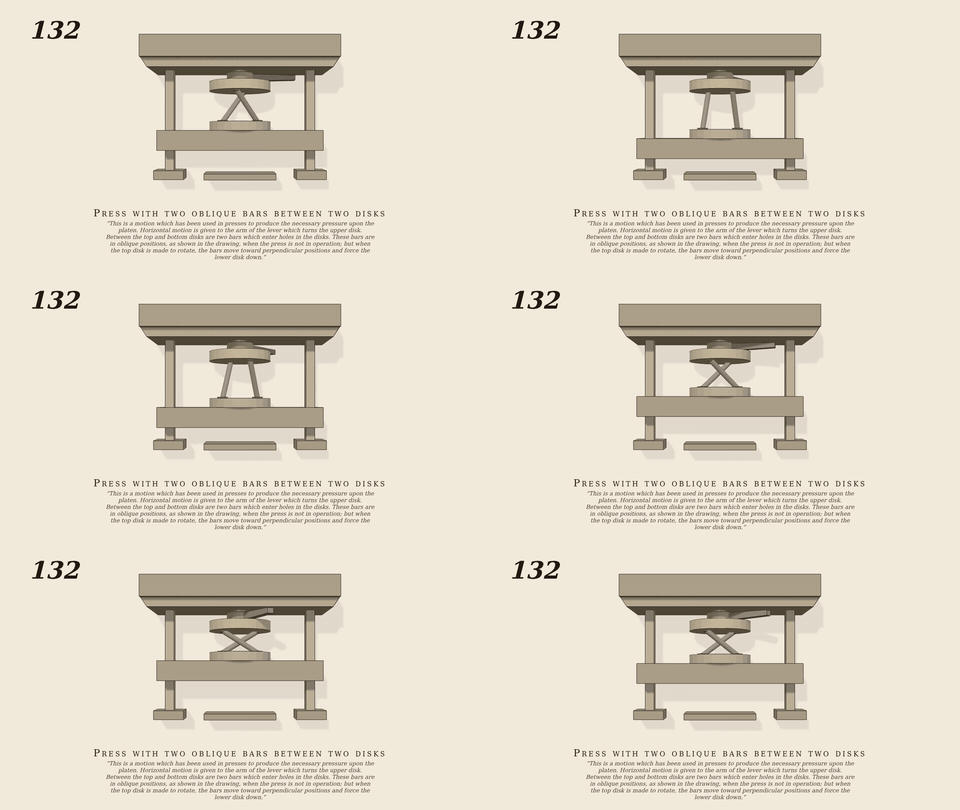
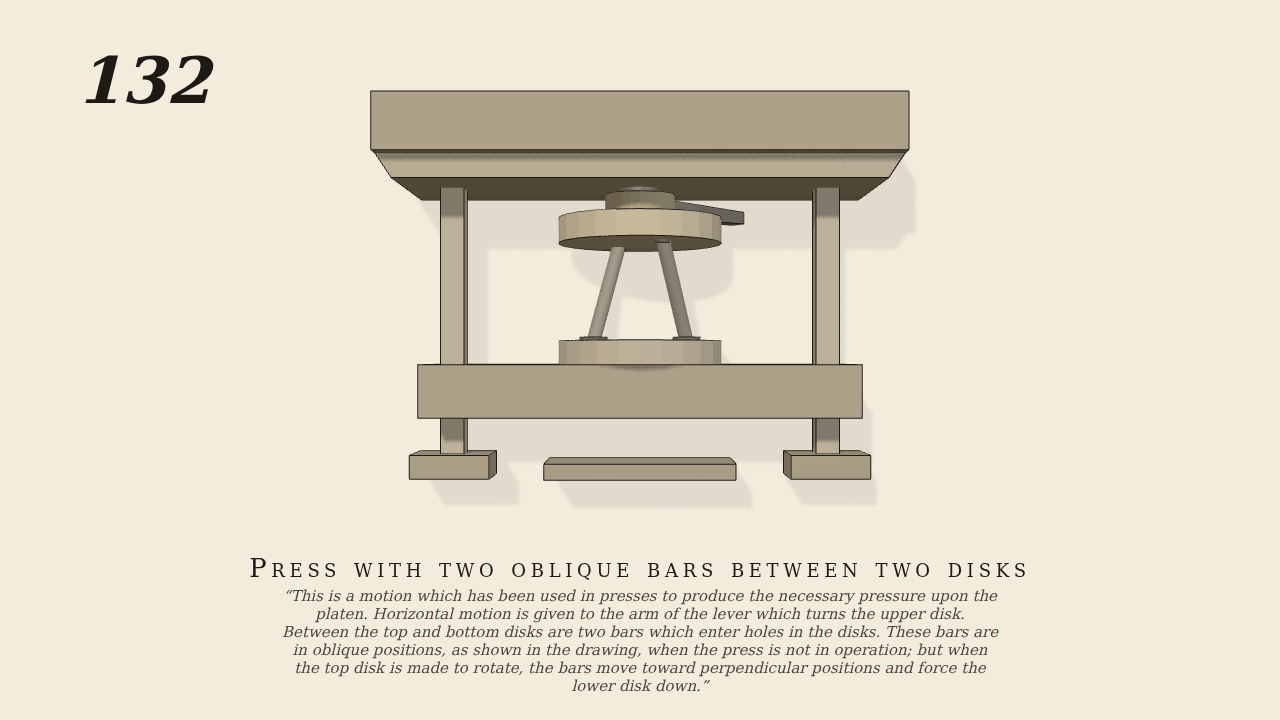
This is a motion which has been used in presses to produce the…
This is a motion which has been used in presses to produce the necessary pressure upon the platen. Horizontal motion is given to the arm of the lever which turns the upper disk. Between the top and bottom disks are two bars which enter holes in the disks. These bars are in oblique positions, as shown in the drawing, when the press is not in operation; but when the top disk is made to rotate, the bars move toward perpendicular positions and force the lower disk down. The top disk must be firmly secured in a stationary position, except as to its revolution.
Only the input is driven; every other part of this model moves by physics (MuJoCo), and its ratios are measured. Run it live, change its parameters, or switch the friction off to see the output stop.
- Modelled as
- The upper disk turns on a vertical axis, swung by a lever (the one driven joint, +-1.1 rad about its start). Two 14 cm bars are pinned in holes of the upper disk 6 cm from the axis and swivel in holes of the lower disk, 6 cm from the axis on the opposite side (a universal joint at the bottom of each bar). The lower disk and platen slide on the vertical axis under the weight of 3 kg. gen132.py.
- Measured
- As the pins come round the platen sits at z = z_top - sqrt(L^2 - 4R^2 cos^2(psi/2)); it descends 0.0250, 0.0249, 0.0334 and 0.0266 m per radian of the lever in four windows (expected 0.0252, 0.0253, 0.0332, 0.0258; r2 0.998 or better). Platen travel -3.16..+2.89 cm for a lever swing of +-63 degrees. No contacts at all, all by pins and hinges.
- Notes
- The bars are oblique when the lever is at one end and straighten as the lever turns: the descent per radian grows as the bars near the upright (toggle) position, which is how the press gets its force.
Film (MP4) · GIF · Still (PNG) · Spec (YAML) · Model (MJCF)