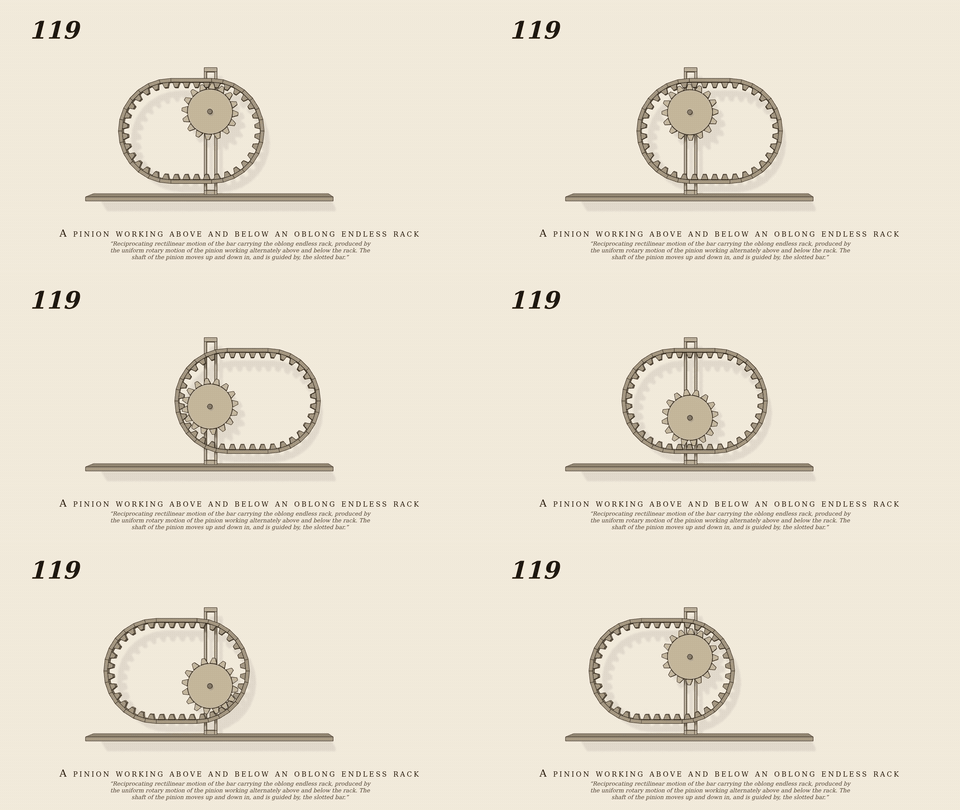
Reciprocating rectilinear motion of the bar carrying the oblong…
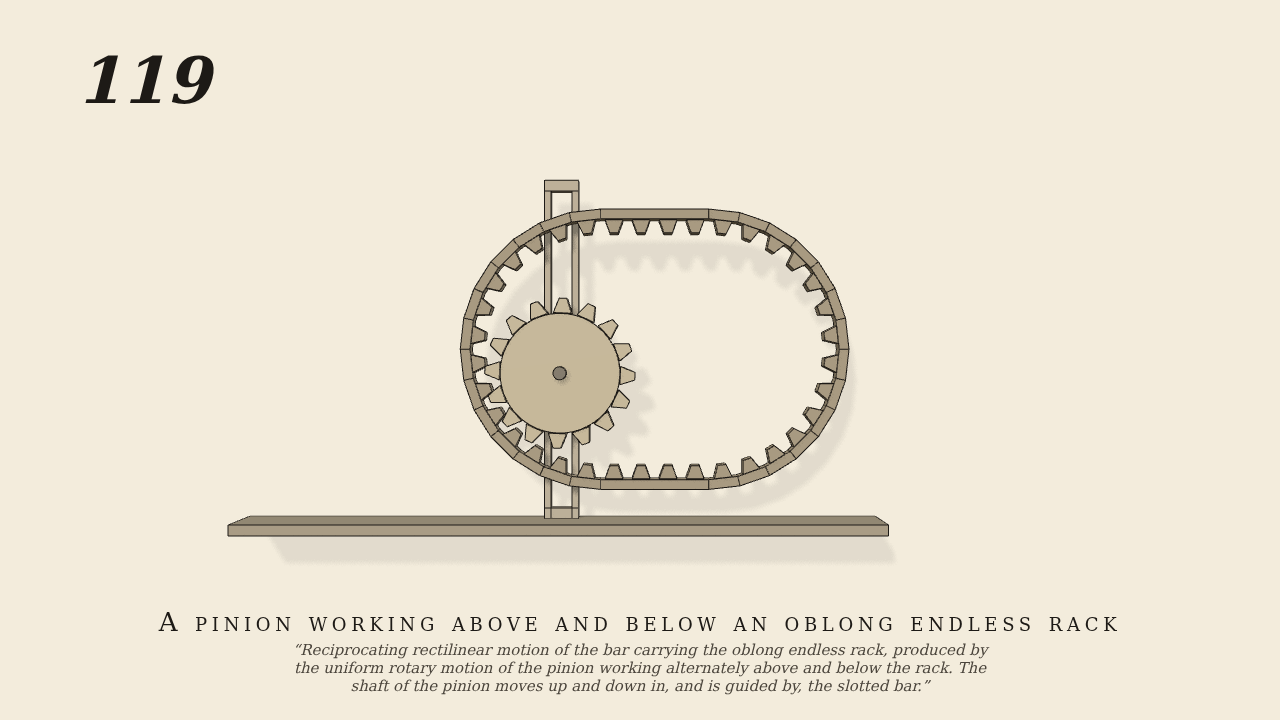
Reciprocating rectilinear motion of the bar carrying the oblong endless rack, produced by the uniform rotary motion of the pinion working alternately above and below the rack. The shaft of the pinion moves up and down in, and is guided by, the slotted bar.
Only the input is driven; every other part of this model moves by physics (MuJoCo), and its ratios are measured. Run it live, change its parameters, or switch the friction off to see the output stop.
- Modelled as
- An oblong endless rack (module 0.8, straight-flanked 20-degree teeth on the inside: 4 along each straight run and 14 round each end) is a bar sliding in x. The pinion (16 teeth), the only driven joint, turns uniformly at 12 rpm and is carried on a shaft that slides up and down in a slotted bar, 4.8 cm either way. No gravity (flat on the bench) and the shaft slides in oil, so only the teeth place it. gen119.py.
- Measured
- Top run: bar follows the pinion at +0.0642 m/rad (r2 0.9998, ideal 0.0640); bottom run the other way -0.0646 (r2 0.9997). Bar goes -4.5 to +14.6 cm, 19.2 cm to and fro. Penetration 0.05 mm.
- Notes
- The speed changes at the round ends (the pinion shaft goes up or down there, so the bar slows to b/a of the pitch speed), as in the original. The sim sets gravity to 0 and the shaft has viscous damping so the pressure angle does not push the pinion away from the rack.
Film (MP4) · GIF · Still (PNG) · Spec (YAML) · Model (MJCF)