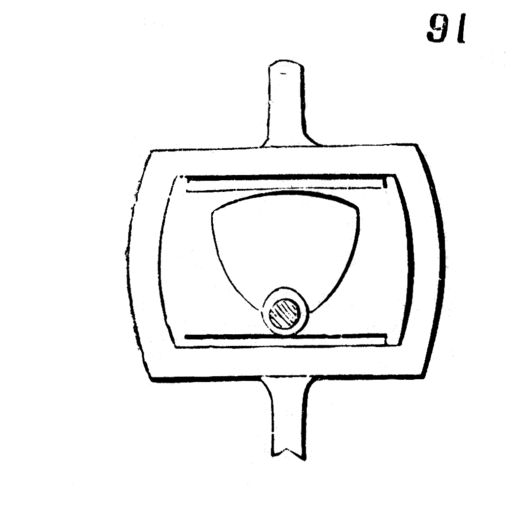
Triangular eccentric, giving an intermittent reciprocating…
Triangular eccentric, giving an intermittent reciprocating rectilinear motion, used in France for the valve motion of steam engines.
Only the input is driven; every other part of this model moves by physics (MuJoCo), and its ratios are measured. Run it live, change its parameters, or switch the friction off to see the output stop.
- Modelled as
- The shaft turns clockwise at 15 rpm and is the only driven joint; at one corner it carries a curved triangle (three arcs, each struck from the opposite corner with the 6 cm side as radius, so 6 cm wide whichever way it turns). It works by real contact between the two horizontal faces of a square yoke 6 cm apart (0.1 mm clearance a side), whose rods slide in fixed guides. While the corner on the shaft is lowest the yoke rests at the top (60 deg of the turn); for 120 deg the arcs about the other corners carry it down; while the arc about the shaft is lowest it rests 6 cm below (60 deg); and it is carried up again in the last 120 deg.
- Measured
- Rests at -0.010 and -6.010 cm (ideal 0 and -6, the clearance); mid-fall slope -0.0509 and mid-rise +0.0510 m/rad vs -0.0506 / +0.0506 (the mean slope of the exact profile over 85-95 deg), r2 0.9999; stroke 6.00 cm. Max penetration 0.004 mm.
- Notes
- The guides are the slide joint (drawn); its damping (3) loads one face each way, a range stop 1.5 cm below the stroke only catches the yoke in the control.
Film (MP4) · GIF · Still (PNG) · Spec (YAML) · Model (MJCF)