A nearly continuous rotary motion is given to the wheel, D, by two…
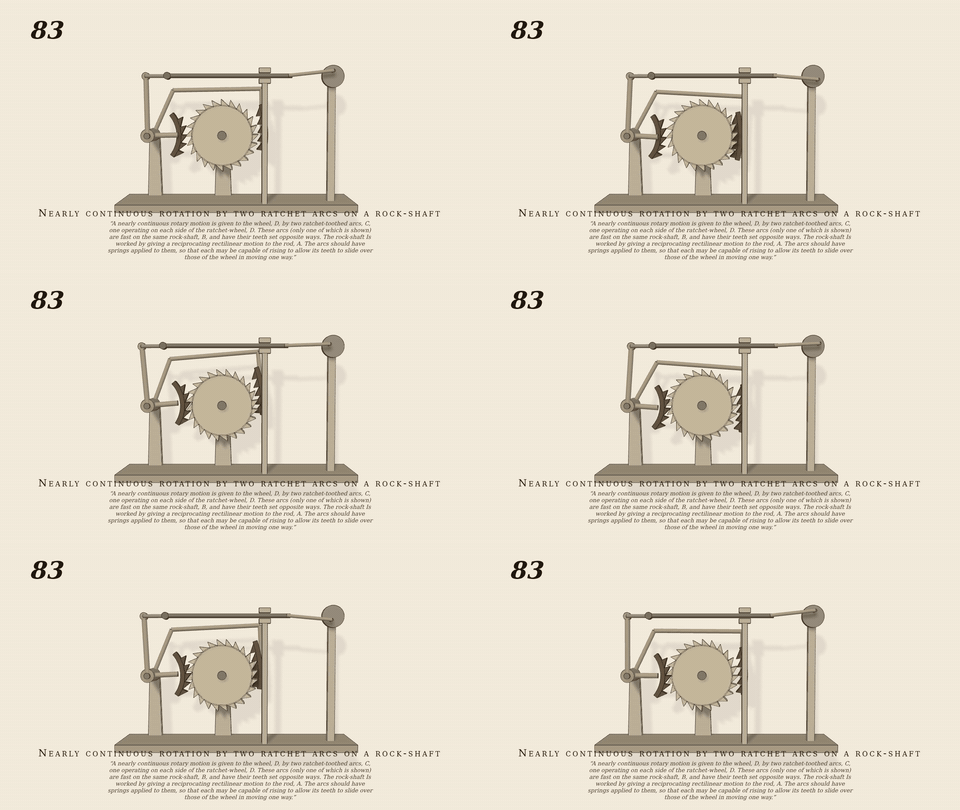
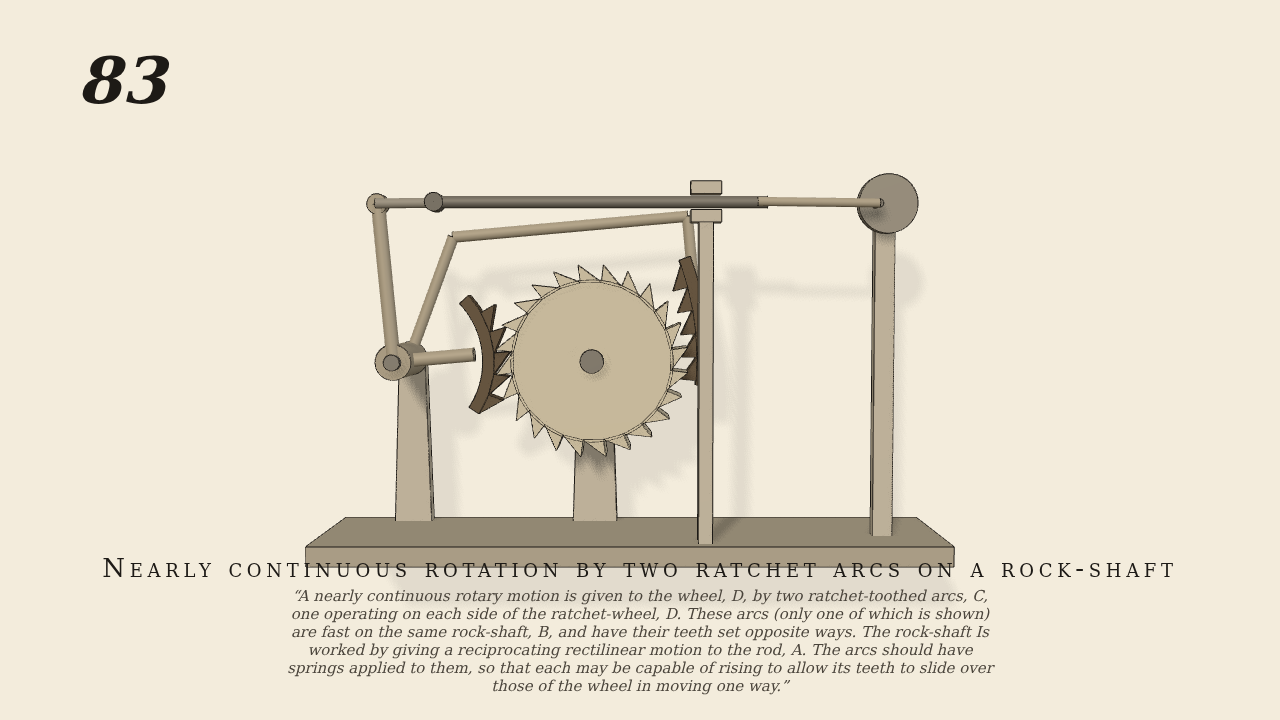
A nearly continuous rotary motion is given to the wheel, D, by two ratchet-toothed arcs, C, one operating on each side of the ratchet-wheel, D. These arcs (only one of which is shown) are fast on the same rock-shaft, B, and have their teeth set opposite ways. The rock-shaft Is worked by giving a reciprocating rectilinear motion to the rod, A. The arcs should have springs applied to them, so that each may be capable of rising to allow its teeth to slide over those of the wheel in moving one way.
Only the input is driven; every other part of this model moves by physics (MuJoCo), and its ratios are measured. Run it live, change its parameters, or switch the friction off to see the output stop.
- Modelled as
- D is a 24-tooth ratchet-wheel (tip radius 5.0) on a fixed centre, held by its bearing friction. The rock-shaft B stands 10 cm to its left. Two 5-tooth arcs are fast on B, each struck about B: the near arc sits in front of D, between B and D's centre (teeth at r 5.4 from B), and the far arc sits behind D and reaches round to its far side (r 14.6). Rocking B moves both arcs the same way, which turns D one way at its near side and the other way at its far side. With their teeth set opposite ways, the near arc drives D on the up stroke and the far arc on the down stroke. Each arc is carried on B by a spring slide (6 N/m, range 1.2 cm), so it can rise and let its teeth slip over D's on its idle stroke. B swings 9.7 deg, worked through a lever by rod A, which slides 1.35 cm to and fro. A crank and connecting-rod drive A; the crank is the only driven joint, at 30 rpm. The two arc strokes add up to 2.8 teeth, so D goes 2 whole teeth per crank turn.
- Measured
- D turns 0.0832 rad per crank rad vs 2/24 = 0.0833 (slip 0.11%), over 3 to 13 s. Max penetration 0.26 mm after 0.5 s (a 0.95 mm start-up transient before 1 s). With only the near arc in contact, D gains 0.65 rad in 10 s vs 2.89 rad with both, about a quarter: one arc alone does not index the wheel.
- Notes
- The arcs' springs are joint springs on their slides, which the rules allow. The far arc is drawn behind the wheel, on the far layer, as Brown's 'only one of which is shown'.
Film (MP4) · GIF · Still (PNG) · Spec (YAML) · Model (MJCF)