The left-hand disk or wheel, C, is the driving-wheel, upon which…
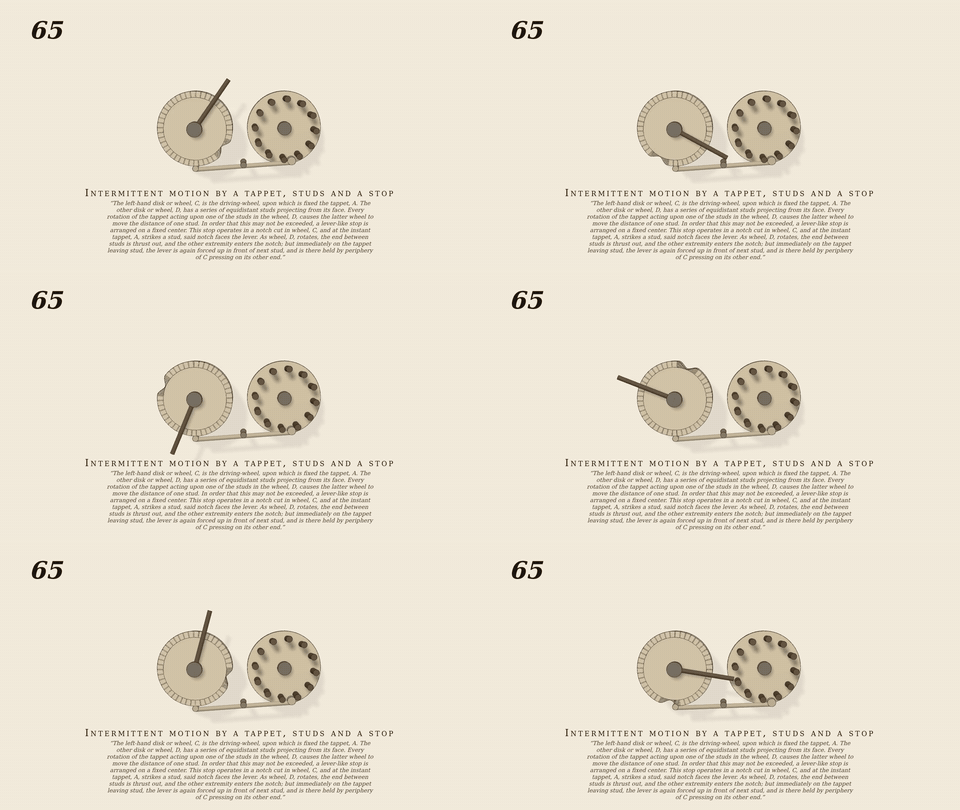
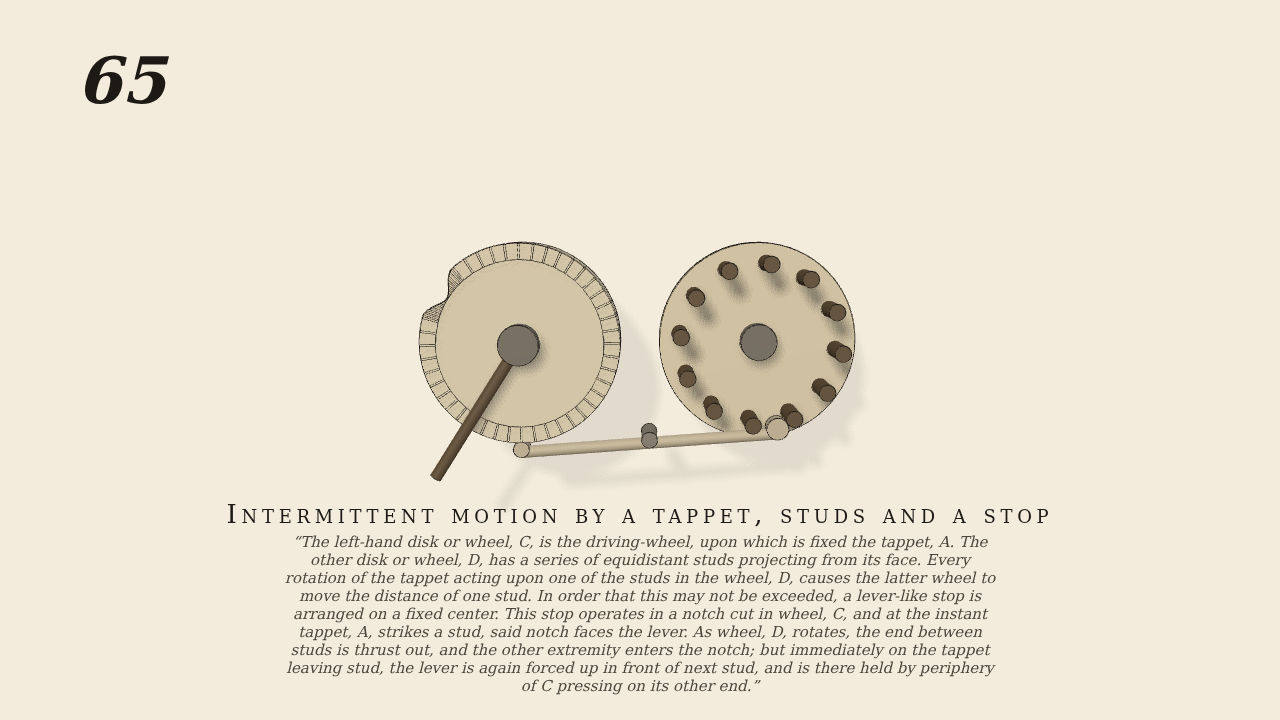
The left-hand disk or wheel, C, is the driving-wheel, upon which is fixed the tappet, A. The other disk or wheel, D, has a series of equidistant studs projecting from its face. Every rotation of the tappet acting upon one of the studs in the wheel, D, causes the latter wheel to move the distance of one stud. In order that this may not be exceeded, a lever-like stop is arranged on a fixed center. This stop operates in a notch cut in wheel, C, and at the instant tappet, A, strikes a stud, said notch faces the lever. As wheel, D, rotates, the end between studs is thrust out, and the other extremity enters the notch; but immediately on the tappet leaving stud, the lever is again forced up in front of next stud, and is there held by periphery of C pressing on its other end.
Only the input is driven; every other part of this model moves by physics (MuJoCo), and its ratios are measured. Run it live, change its parameters, or switch the friction off to see the output stop.
- Modelled as
- Brown's figure 65: C at the left (the driven shaft) carries the tappet A on its face and a notch in its rim; D at the right has 12 studs on its face; a stop lever on a fixed centre below has its right end between two studs and its left end held up against C's rim by a light spring
- Measured
- D/C −0.0833 over four turns (−1/12, one stud a turn; 12 rpm), D stands between strokes (still); also −0.0827 at 8 rpm and −0.0841 at 20 rpm; max penetration 0.08 mm
- Notes
- C's rim and notch are overlapping convex slices that dip a little below the outline at their ends: with plain slices the stop's left end caught on a seam (a sideways contact normal) and stalled C. The notch is a smooth hollow (raised cosine), so its trailing edge cams the stop back up in front of the next stud. D's bearing is nearly free (damping 0.002), so the stop has work to do. batch8/gen065.py. Negative control: the stop's right end out of contact → D coasts on past the next stud (−0.188 instead of −0.083).
Film (MP4) · GIF · Still (PNG) · Spec (YAML) · Model (MJCF)