For transmitting two speeds, one of which is a different and…
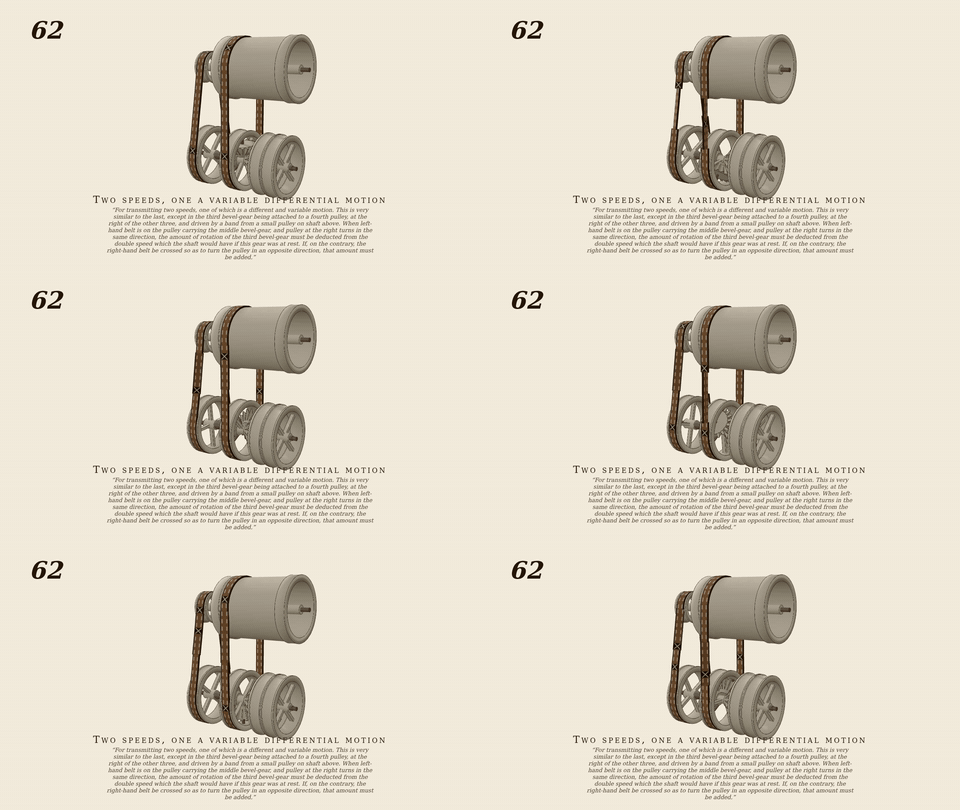
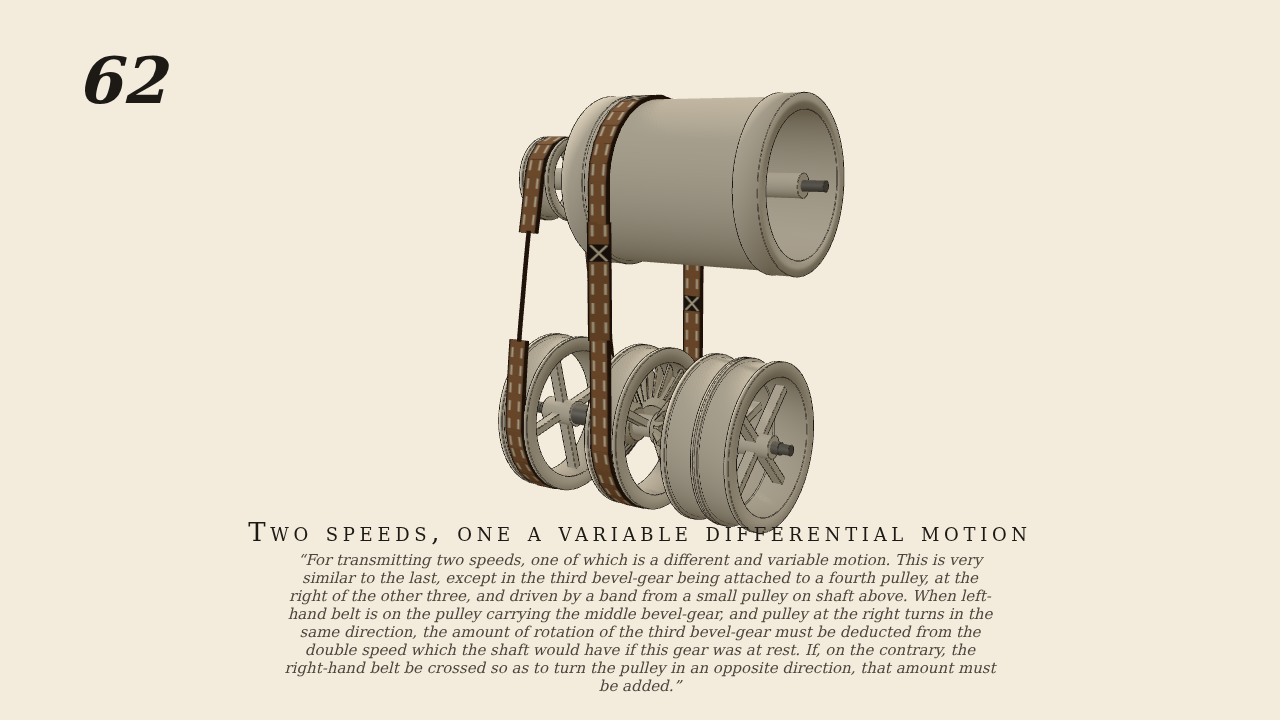
For transmitting two speeds, one of which is a different and variable motion. This is very similar to the last, except in the third bevel-gear being attached to a fourth pulley, at the right of the other three, and driven by a band from a small pulley on shaft above. When left-hand belt is on the pulley carrying the middle bevel-gear, and pulley at the right turns in the same direction, the amount of rotation of the third bevel-gear must be deducted from the double speed which the shaft would have if this gear was at rest. If, on the contrary, the right-hand belt be crossed so as to turn the pulley in an opposite direction, that amount must be added.
Only the input is driven; every other part of this model moves by physics (MuJoCo), and its ratios are measured. Run it live, change its parameters, or switch the friction off to see the output stop.
- Modelled as
- Brown's figure 62: No. 61 with the third bevel C fast on a fourth pulley, driven the drum's way by its own band from a small pulley (r 3.5) on the upper shaft; the left band on the pulley carrying B
- Measured
- C 0.5033 (3.5/7), shaft 1.4738 (2 − 0.5 = 1.5, less creep); on the bevels themselves shaft = 2·carrier − C to 0.0003 (test_062); middle-pulley variant 0.9908 (1); max penetration 0.55 mm
- Notes
- Brown's crossed-band case (C's rotation added) is the same machine with a crossed band and is not built. C's band needed damping 6 and pretension 80 (it flapped in bursts, driven by the bevels' tooth ripple). At 30 rpm the ratios still hold (C 0.5005, shaft 1.4703) but C's band flaps (1.76 radial) and fails belt_on; stiffening it to 48000 did not cure it. batch7/gen062.py. Negative control: the fourth pulley unkeyed from C → C runs free (1.57 instead of 0.5).
Film (MP4) · GIF · Still (PNG) · Spec (YAML) · Model (MJCF)