Frictional grooved gearing
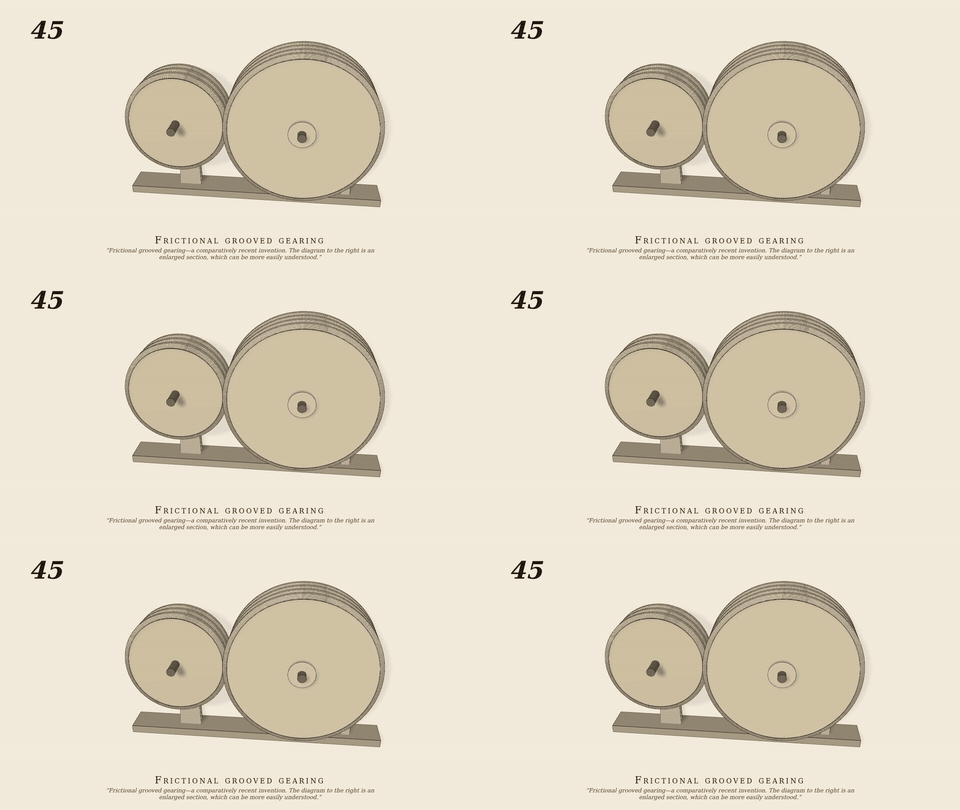
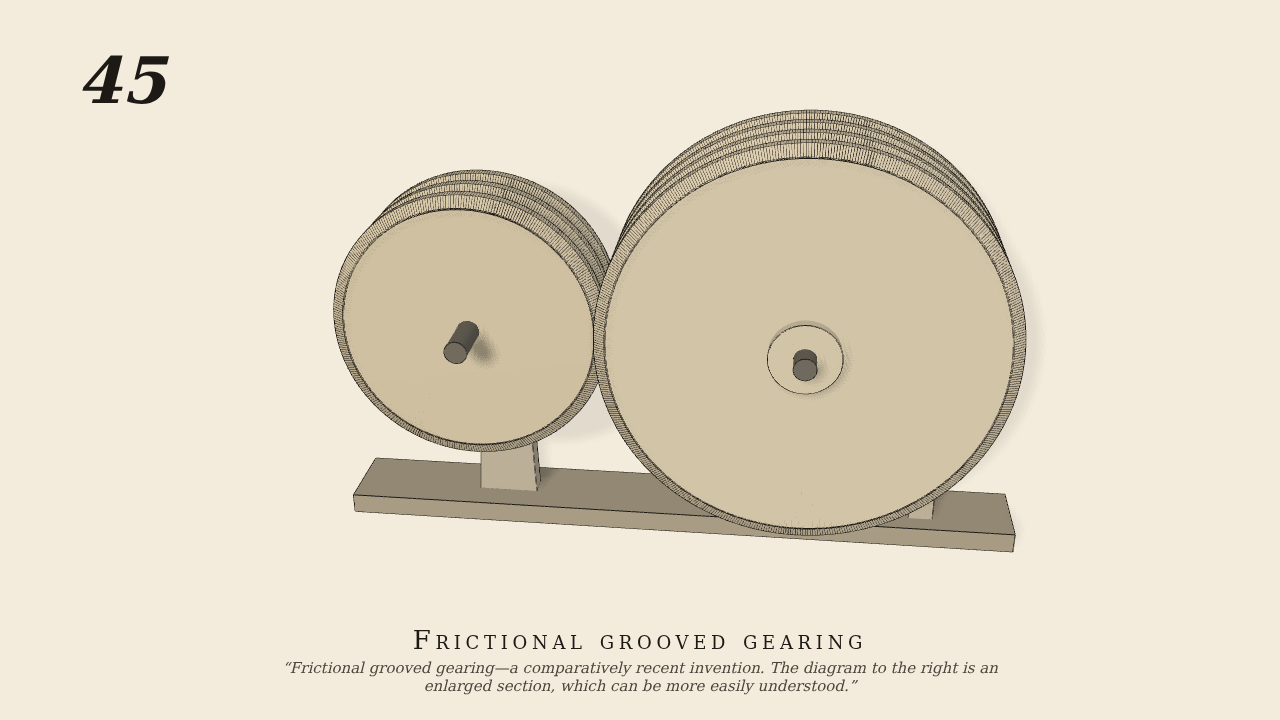
Frictional grooved gearing—a comparatively recent invention. The diagram to the right is an enlarged section, which can be more easily understood.
Only the input is driven; every other part of this model moves by physics (MuJoCo), and its ratios are measured. Run it live, change its parameters, or switch the friction off to see the output stop.
- Modelled as
- two wheels with V-ridged rims (flanks at 30°, 0.8 apart): three ridges on the driver (pitch r 6) wedge into the follower's grooves and four on the follower (pitch r 9) into the driver's; each ridge a ring of convex segments (331 and 503, counts that cannot mesh like teeth); the follower's bearing is a carriage pulled in by a spring
- Measured
- −0.607, by friction on the flanks alone (pitch-line ratio −0.667; the flanks bear half at their tips and half at their roots, where they would roll at −0.714 and −0.622, so they rub and the follower creeps)
- Notes
- Only the driver is motor-driven. With 72/108 segments the facets meshed like 2:3 teeth and drove the follower even frictionless; a flank bent out to bear at the pitch line made the facet edges catch too. Robust in 6 perturbed runs. Negative control: flanks frictionless (μ≈0) → the follower stands (0.0002). Heavy model (~3000 hulls, 22 s wall for 6 s).
Film (MP4) · GIF · Still (PNG) · Spec (YAML) · Model (MJCF)