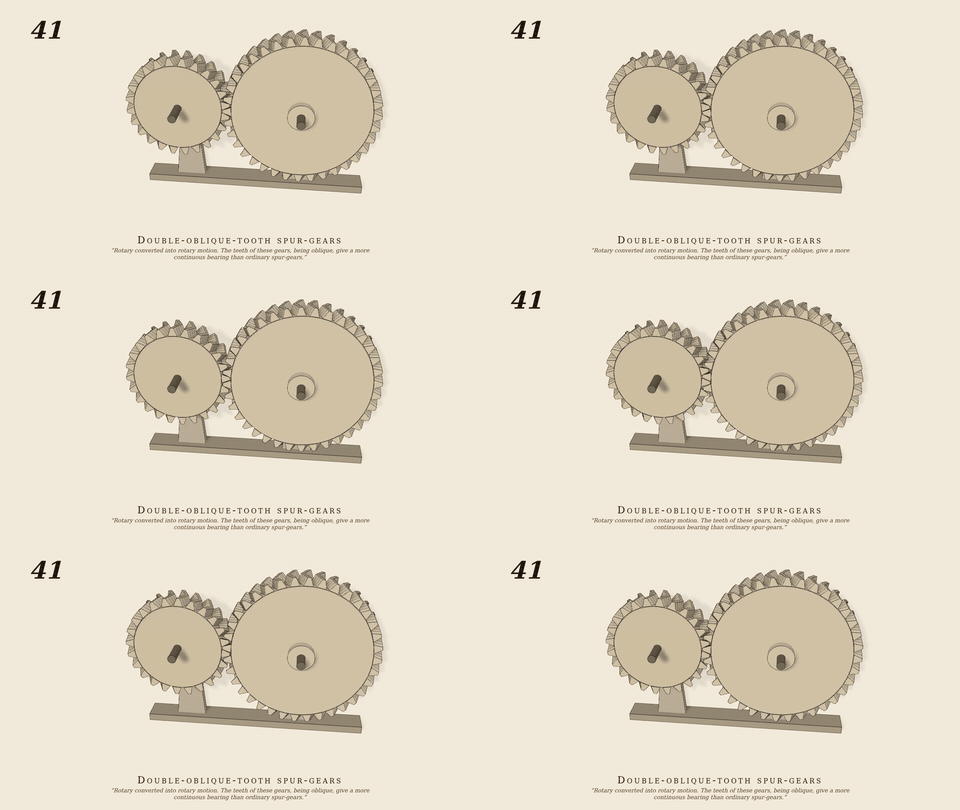
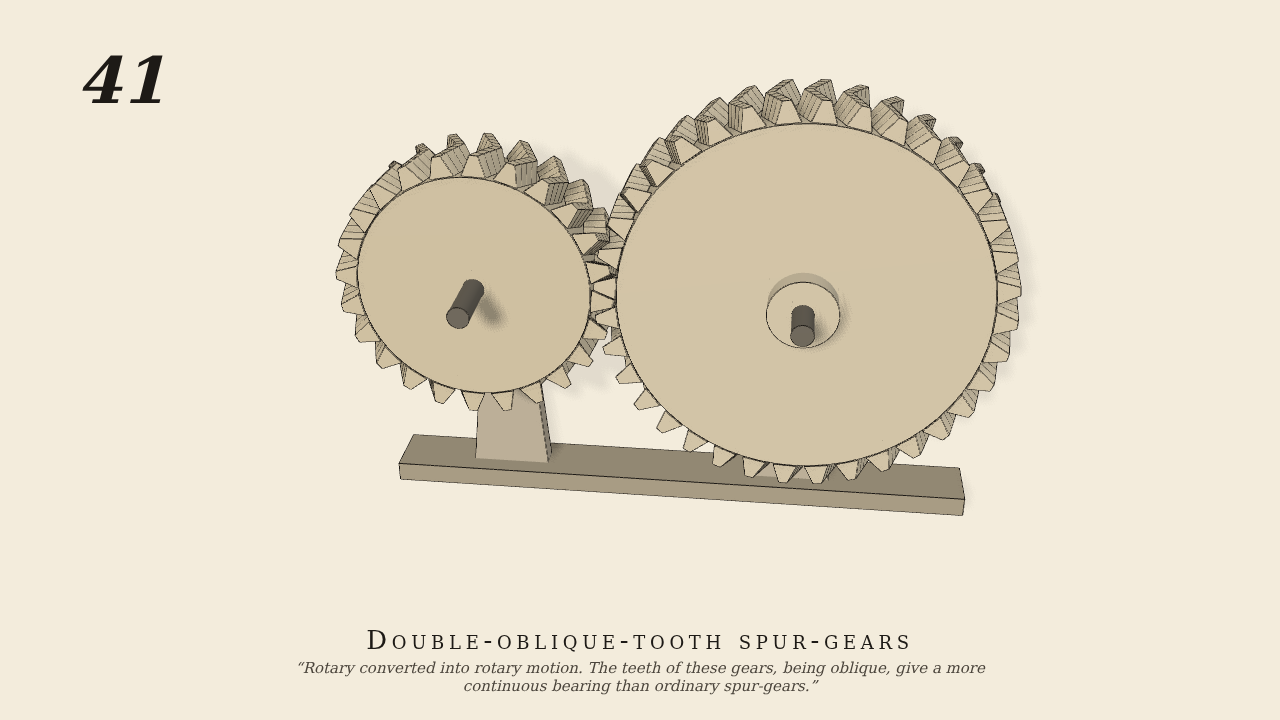
Double-oblique-tooth spur-gears
40 and 41. Rotary converted into rotary motion. The teeth of these gears, being oblique, give a more continuous bearing than ordinary spur-gears.
Only the input is driven; every other part of this model moves by physics (MuJoCo), and its ratios are measured. Run it live, change its parameters, or switch the friction off to see the output stop.
- Modelled as
- as No. 40 (24 and 36 teeth, face 3) but each tooth oblique both ways from the middle of the face, a V at 25° each side
- Measured
- −0.6667 (ideal −24/36); slices of 1/24 s within −0.685..−0.651
- Notes
- shared plate 40–41; the plate's second pair is read as the V (double-oblique) form, whose halves' end thrusts balance. Driver kv 1: at kv 4 one of 6 perturbed runs blew up at the first tooth contact; at kv 1 all 6 run clean. Negative control: the driver's teeth out of contact → the follower stands (0.0000).
Film (MP4) · GIF · Still (PNG) · Spec (YAML) · Model (MJCF)