Brush-wheels
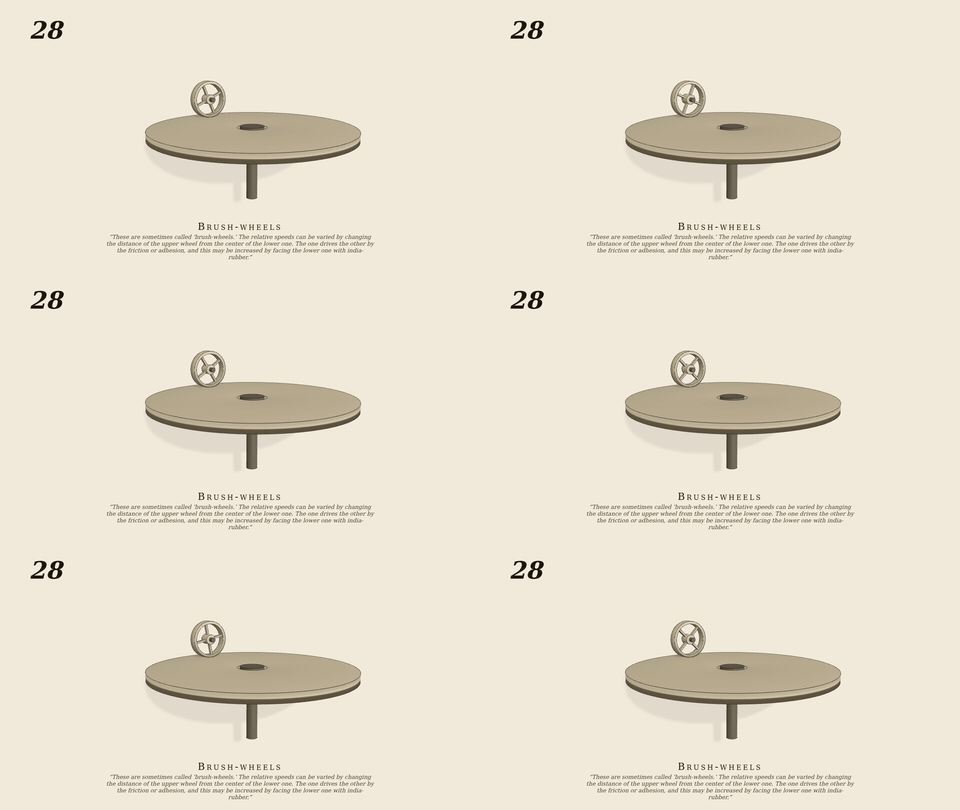
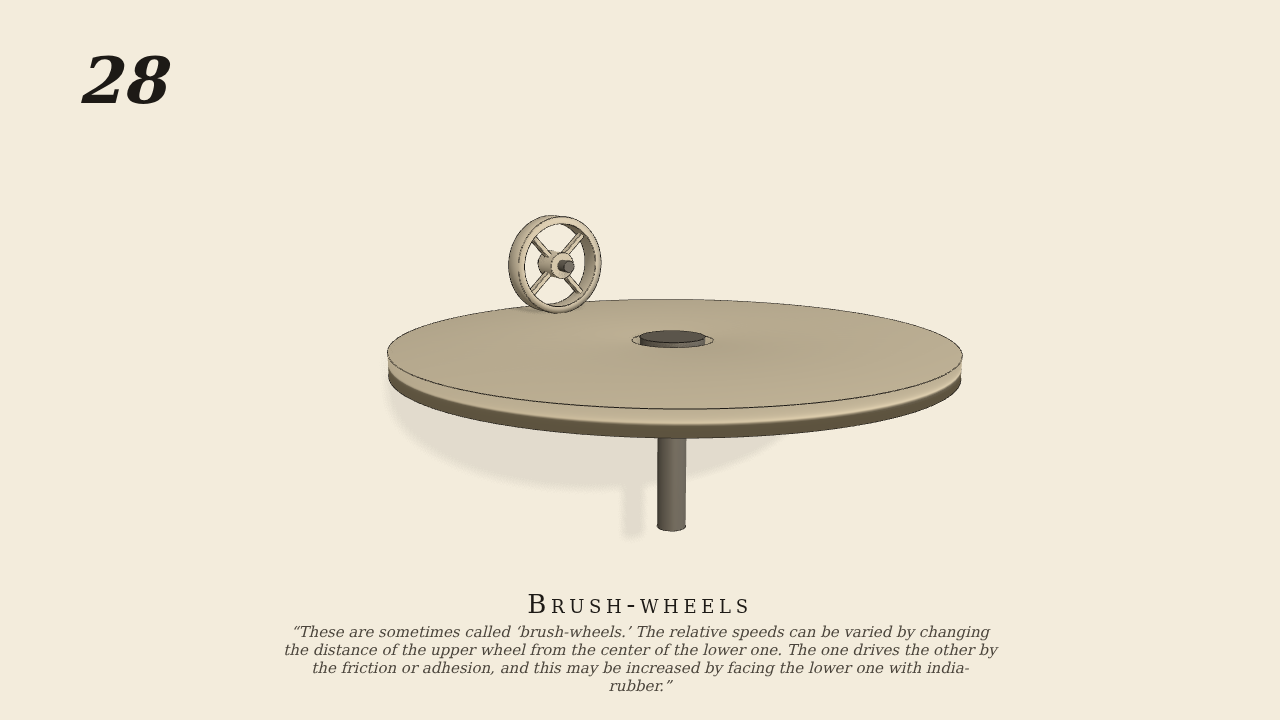
These are sometimes called “brush-wheels.” The relative speeds can be varied by changing the distance of the upper wheel from the center of the lower one. The one drives the other by the friction or adhesion, and this may be increased by facing the lower one with india-rubber.
Only the input is driven; every other part of this model moves by physics (MuJoCo), and its ratios are measured. Run it live, change its parameters, or switch the friction off to see the output stop.
- Modelled as
- a horizontal disc (r 15, india-rubber faced, friction 0.8) on a vertical shaft, and a small wheel (r 3) on a horizontal shaft along a radius, resting on the disc's face by its own weight (2 kg) in a bearing free to rise and fall; three passive settings slide it to r_c = 6, 9, 12
- Measured
- ω_w/ω_d = 1.976 / 2.973 / 3.969 (r_c/r_w = 2 / 3 / 4: about 1 % slow, the rim's width twisting on the face) against a 0.03 N·m load
- Notes
- Only the disc is motor-driven (30 rpm). Negative control: friction ≈ 0 → the small wheel stands (0.0003 at every setting). New: variant `body_pos`, a flat-faced profile wheel that `touch`es, and the transverse inertia of profile wheels corrected (it was half its true value; Nos. 9 and 10 turn only about their axes and test the same).
Film (MP4) · GIF · Still (PNG) · Spec (YAML) · Model (MJCF)