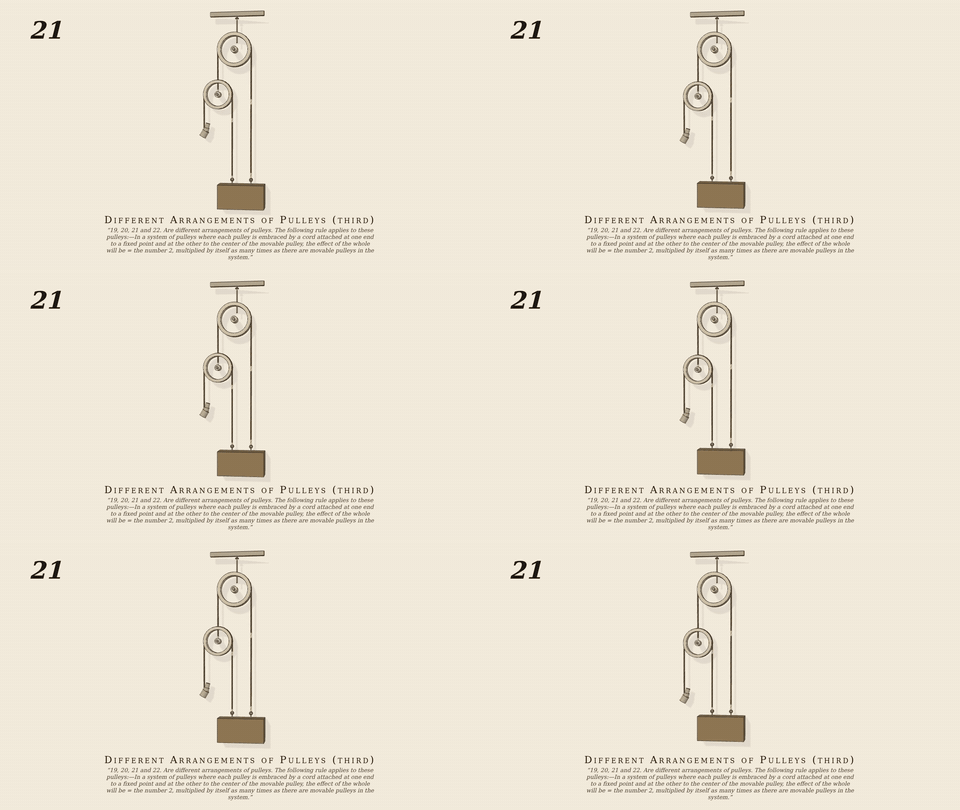
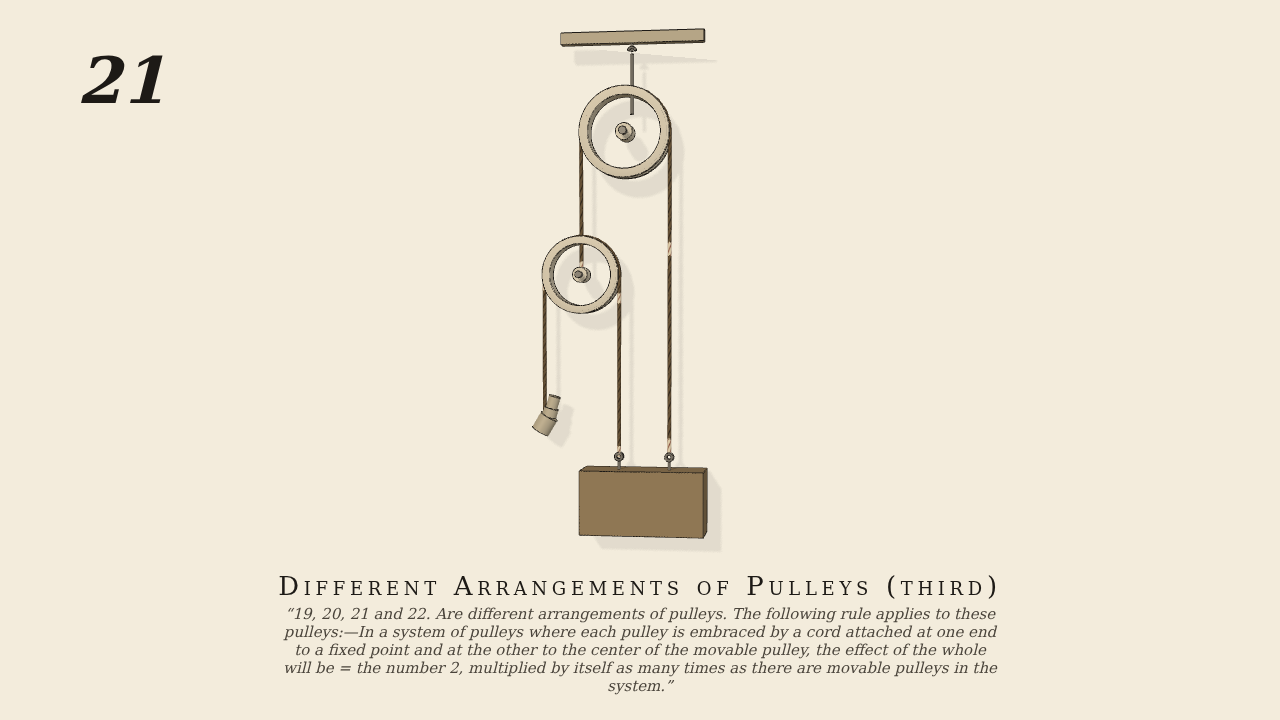
Different arrangements of pulleys
19, 20, 21 and 22. Are different arrangements of pulleys. The following rule applies to these pulleys:—In a system of pulleys where each pulley is embraced by a cord attached at one end to a fixed point and at the other to the center of the movable pulley, the effect of the whole will be = the number 2, multiplied by itself as many times as there are movable pulleys in the system.
Only the input is driven; every other part of this model moves by physics (MuJoCo), and its ratios are measured. Run it live, change its parameters, or switch the friction off to see the output stop.
- Modelled as
- two cords of links (friction on the sheaves): the standing cord, 46 hemp links, from the movable sheave's axle plumb up out through its rim, over the fixed sheave to the weight's right eye; the hauling cord, 44 links, from the weight's left eye up over the movable sheave and down to the hand
- Measured
- load/hand 0.333 (three parts of cord buy one of rise), sheave/hand −0.333, fixed sheave −3.68 and movable sheave −8.62 rad/m (strand speeds: −3.70, −8.66), pull 53.4 N against (W + W_sheave)/3 less the hand's weight 53.3 N, pen ≤ 0.05 mm
- Notes
- Only the hand is driven (a slide in a plumb guide on the hauling part, 6 cm/s, at most 600 N). Shared plate 19–22. The plate's loose end hangs off at a slant; the hand hauls it plumb. Cord `clear_through:` lets the standing cord leave its sheave through the rim. Negative control: both cords' contact switched off → the load does not rise (0.000; it drops to its stop while the hand still hauls).
Film (MP4) · GIF · Still (PNG) · Spec (YAML) · Model (MJCF)