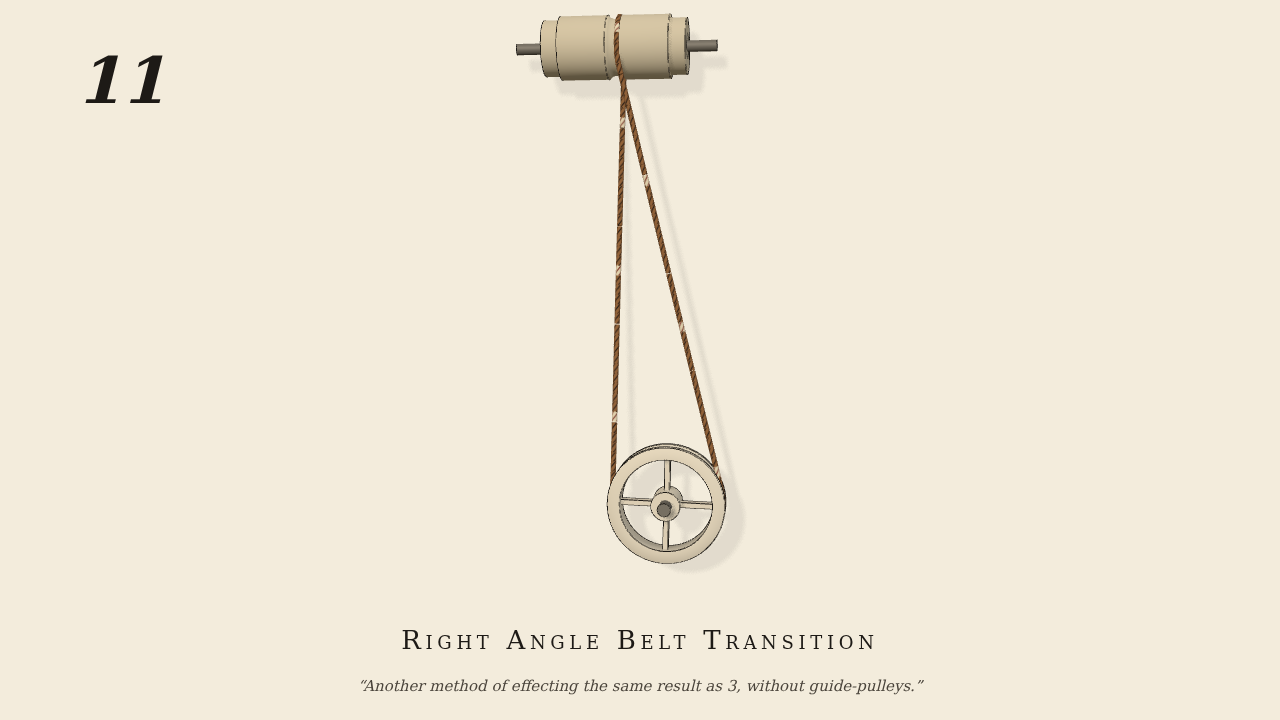
Right Angle Belt Transition
Another method of effecting the same result as 3, without guide-pulleys.
Only the input is driven; every other part of this model moves by physics (MuJoCo), and its ratios are measured. Run it live, change its parameters, or switch the friction off to see the output stop.
- Modelled as
- The quarter-turn drive, seen from the front as Brown draws it: a drum (6 cm across, 12 cm long) on a shaft running left and right, 50 cm above a 12 cm four-spoked pulley whose shaft points at the viewer, joined by a round cord (6 mm, friction, 120-link elastic chain, 20 N) in a groove at the middle of the drum and in the pulley's groove. No guide pulleys: the drum is set back 3 cm behind the pulley's plane and 6 cm to its left, so the leaf coming down off the drum's front is already in the pulley's plane (slanting to its right side) and the leaf rising off the pulley's left side goes up in the drum's plane to its back, each run turning a quarter. Only the drum is driven (30 rpm); the pulley turns by the cord's grip against a light load. gen011.py.
- Measured
- Pulley/drum 0.5046 over 1-7 s (cord centre-line geometry 3.3/6.3 = 0.5238, 3.7% creep); cord within 0.6 cm of its path (belt_on); penetration 1.95 mm (limit 2.5). With the cord's grip taken off (mu~0) the drum turns in it and the pulley stands. Motion audit notes the smooth drum's turning is hard to see (11 px sweep); gate passes.
- Notes
- A round cord, not Brown's flat belt; the drum has a groove at its middle (a plain drum let the cord walk to its end flange); the wheels are smaller against the span than Brown's so the cord meets each groove at under 7 degrees.
Film (MP4) · Still (PNG) · Spec (YAML) · Model (MJCF)